In shortThe ruins climb the slope above the town at 2,360 m, and the regional culture office splits them into two main sectors, Qosqo Ayllu and Araccama Ayllu. The gate opens at 07:00 and closes at 16:30, and entry runs on the Cusco Tourist Ticket: S/130 for ten days, or S/70 for the valley circuit. The flat circuit takes about 35 minutes. From the station below, trains reach Aguas Calientes in roughly 1 hour 45 minutes.
2,360 mTown and station altitude
07:00–16:30Gate hours at the ruins
about 1 h 45 minTrain to Aguas Calientes
S/130Cusco Tourist Ticket, 10 days
What there is to see above the town
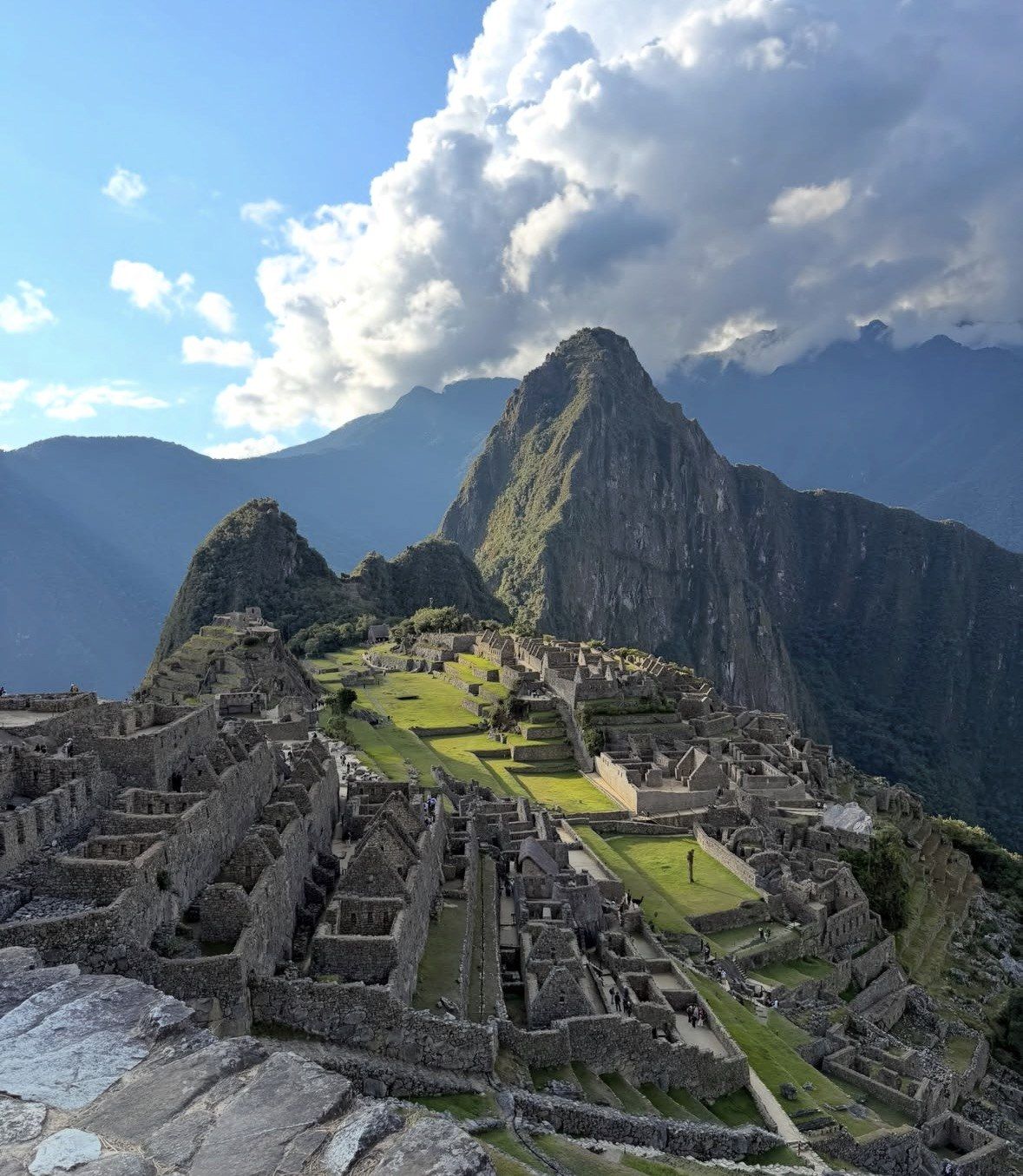
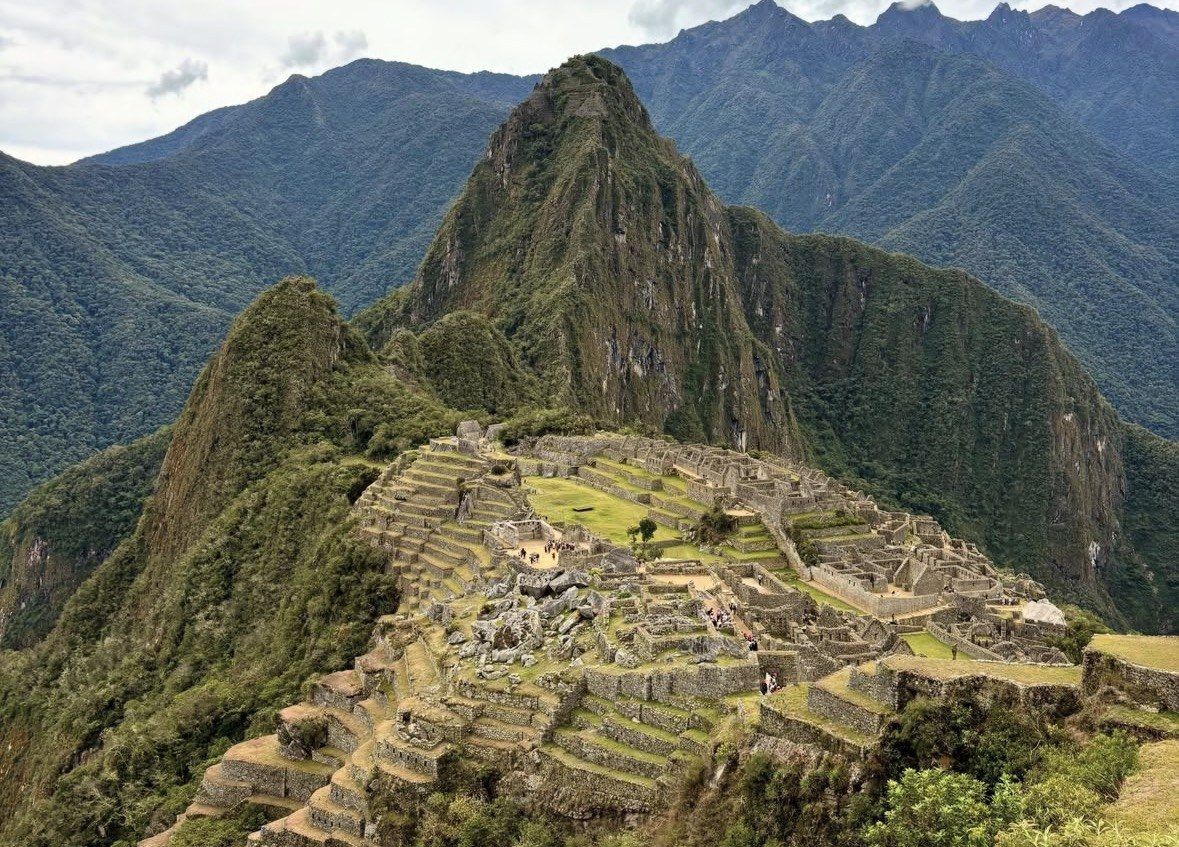
The site sits on the slope at the western edge of town: long steps of agricultural terracing, with a temple sector of massive worked blocks on the ground above. The regional culture office divides the archaeological park into Qosqo Ayllu and Araccama Ayllu and puts its area at 34,800 hectares with a perimeter of 156,350 linear metres, of which the walked part is one small corner. Stand on the terracing and you are on stonework whose author the colonial chroniclers never settled: Sarmiento de Gamboa hands the work to Pachacútec, whose reign ran 1438 to 1471, while Garcilaso de la Vega gives it to Wiracocha.
Opening is 07:00 to 16:30. There is a ramp at the entrance and a flat circuit of roughly 35 minutes for anyone staying off the stairs; climbing the terracing to the temple sector and coming back down takes considerably longer, and most people walk the lower town afterwards. Give it half a morning rather than slotting it between two other stops.
Entry is on the Cusco Tourist Ticket. The full version costs S/130 for foreign visitors and runs 10 days across all three circuits; the partial Circuit III ticket is S/70, valid 2 days, and covers Pisac, Ollantaytambo, Chinchero and Moray. Hold a Peruvian document or a foreign student card and the integral ticket falls to S/70, with S/40 for national students. The counter here will want the paperwork that goes with a student rate: between 10 and 17 an identity document is enough, from 18 to 25 you need a valid student card or an ISIC card. On the two-day trip listed below, this is the one item you pay in Peruvian soles, in cash, at the ruins entrance.
The town below the terraces still follows its Inca street plan, with water channels running beside the lanes and old walls built into houses that people live in. Inside the archaeological area the standard rules for Cusco-region parks apply: no food, animals, alcohol or drugs, no climbing on or painting walls, no camping on site, no drones without authorisation from the Cusco culture office, and no commercial filming or photography without permission.
Getting here from Cusco by road
Reckon on about 1 hour 30 minutes behind the wheel. Two paved approaches end at this town in the culture office's listing: the 61 km line over Chinchero and down through Urubamba, or the longer 92 km swing by Pisac, Calca and Urubamba. Take the Chinchero road if you are heading straight for a train, and the Pisac road if the valley sites are the point of the day.
Closing times decide the order of a valley day more than distances do. Chinchero runs latest, Moray closes an hour earlier, and Pisaq and Ollantaytambo both lock the gate at 16:30, so put the far stops in the morning and leave the terraces here for late morning or early afternoon before a train.
- Two paved approaches: the 61 km Chinchero and Urubamba line, or 92 km round by Pisac, Calca and Urubamba
- Chinchero, at an average 3,750 m, stays open until 18:00
- Moray, about 3,480 m, closes at 17:00
- The Pisaq park, about 3,400 m, closes at 16:30, the same hour as Ollantaytambo
- A packaged day from Cusco publishes pickup around 05:20, roughly 2 hours by van and the 08:29 train arriving 09:54
Valley sites, then the train from Ollantaytambo
From $449 over two days, rated 4.8 ★ (1294 reviews), this one takes in the Sacred Valley on the way down, gives you a private room in Aguas Calientes for the night and holds Circuit 2 priority, subject to Ministry availability, for the morning after.
★ 4.8/5 · 1,294 reviews
How Ollantaytambo station works
The station is on Av. Ferrocarril, a few minutes' walk below the ruins at the bottom of town. The PeruRail counter inside works a 04:15 to 21:00 day with no break for holidays, which is what makes the pre-dawn departures from this platform workable at all. Boarding stops half an hour before a train pulls out, and Inca Rail wants its passengers at the station 30 minutes ahead as well. Treat half an hour as the floor, and allow more if you still have bags to leave in the store.
Baggage is the part that catches people out. On a PeruRail service the allowance is one backpack at 8 kg and 100 cm of total dimensions, or one carry-on at 12 kg and 115 cm; Inca Rail counts a single hand item of 8 kg and sends anything bigger into custody. The luggage store at the station takes the rest at no charge over the same 04:15 to 21:00 hours, and the equivalent store at Machu Picchu station in Aguas Calientes runs 05:00 to 22:00.
| Detail | What the operators publish |
|---|
| Ticket office, Av. Ferrocarril s/n | 04:15 to 21:00 daily, holidays included |
|---|
| Boarding | Closes 30 minutes before departure; Inca Rail advises arriving at least 30 minutes early |
|---|
| Hand baggage, PeruRail | One backpack up to 8 kg and 100 cm, or one carry-on up to 12 kg and 115 cm |
|---|
| Hand baggage, Inca Rail | One hand item up to 8 kg; larger bags left in custody |
|---|
| Excess baggage, PeruRail | $15 carry-on and $25 checked bag on the Machu Picchu route; $5 and $10 on the Ollantaytambo route |
|---|
| Luggage store | Ollantaytambo 04:15 to 21:00 and Aguas Calientes 05:00 to 22:00, at no charge, every day |
|---|
| Day-tour advice | No more than 5 kg plus a small backpack, and train times are indicative |
|---|
The rail leg down to Aguas Calientes
Ollantaytambo to Machu Picchu is the short way in. PeruRail's own site gives about 1 hour 45 minutes to Aguas Calientes, and Peru's national tourism board rounds the same leg to about 2 hours. Timetables shift, so work from the hour printed on your own ticket and check it the day before. The citadel entrance is not part of a plain train fare, which the operator states on its service pages.
Services that start in Cusco are bimodal. Departure is from San Pedro or Poroy, and on selected schedules since 1 September 2025 the switch from bus to rail happens at Pachar, a short way down the valley from this platform. Poroy to Aguas Calientes is published at about 3 hours 30 minutes against the Ollantaytambo figure, so if your plan allows it, come up by road and board a train at this station.
Sleeping here before an early departure
At 2,360 m the town is a kilometre below Cusco's 3,399 m and only twenty metres above the citadel, which makes it the obvious place in the valley to drop some altitude if the first days in Cusco went badly. Even the 2,792 m high point on the road and rail route to Machu Picchu sits lower than the streets of Cusco.
A bed in town also removes the pre-dawn drive from Cusco. The ticket office and the luggage store both open at 04:15, so the earliest trains are reachable on foot, and you can see the terraces the afternoon before instead of squeezing them into the day you travel.
What a night here will not buy you is the first entry hour at the citadel. A 06:00 or 07:00 slot means sleeping in Aguas Calientes, where the first shuttle rolls at 5:30 a.m. and the climb to the gate covers 8 km on roughly 13 hairpins in 20 to 25 minutes. Up there your entry is tied to the hour printed on the ticket, with 30 minutes of grace in low season and 45 in high season. That entrance is nominal: your full name and ID number are on it, and neither the name nor the date can be changed later.
How to fit the ruins, the valley and the train together
The shape that works for most trips is a valley day finishing at this station, a night below the ridge, and the citadel early the next morning. Done that way the terraces get the time they deserve, the Cusco Tourist Ticket earns its S/70 or S/130, and the printed entry hour on your Machu Picchu ticket no longer rides on traffic between Cusco and Pachar.
One day out of Cusco points at the Machu Picchu Tour Full Day by Train, a 16-hour option from $419, rated 5.0 ★ (321 reviews). It boards the Expedition train at this station for Aguas Calientes and returns the same way, with the shuttle up to the gate and back down, expert guides and the entrance ticket, its circuit allocated subject to availability. The operator advises booking around five months ahead and refunds in full if you cancel at least 24 hours before departure. That day passes through the town without stopping in it, so see the valley on another day if the terraces matter to you.
Train classes, bimodal schedules and what each fare does and does not cover are set out on the train pages of this site. Read those before you fix the hour on your entrance ticket, because the rail timetable is what decides which entry band you can realistically hold.
Questions people ask
Does the Cusco Tourist Ticket get me into Machu Picchu as well?
No. It covers the archaeological park here along with Pisac, Chinchero and Moray on the S/70 Circuit III ticket, or all three circuits for 10 days at S/130 for foreign visitors. The citadel entrance is a separate nominal ticket carrying your full name and ID document number, sold only through the Ministry of Culture's official portal, an authorised counter or an agency registered with its Cusco office. A train fare does not include it either.
My train leaves before the ruins open. Can I still see them?
The park gate opens at 07:00, so an earlier departure means visiting the afternoon before or on your way back through. Coming back works only if your return train gets you in well before 16:30, when the park closes. The station ticket office and the luggage store open at 04:15, so an early train is easy enough to make from a bed in town.
Can I fit the ruins into a one-day Machu Picchu trip from Cusco?
Realistically no. An operator's own schedule for the packaged day comes to roughly 15 hours between hotel doors: collection at about 05:20, some 2 hours in the van, the 08:29 train landing at 09:54, a slot inside the site falling between 11:00 and 14:00, and Cusco again near 20:40. The town is a transit point on that schedule. If you want both, take the two-day trip with the valley day and the night in Aguas Calientes.
What time of year suits a visit here?
PeruRail's destination page puts the dry months, April to October, as the window for this town and the valley around it. Bear in mind that the citadel's 2026 high season covers 19 June to 2 November, plus 1 January, 2 to 5 April and 30 and 31 December, with 5,600 places a day against 4,500 on other dates, so booking leads are longest exactly when the valley weather is driest.
Is the site manageable without climbing stairs?
Partly. The culture office lists a ramp at the entrance and a flat circuit of about 35 minutes, which keeps you on the lower ground. The terraces and the temple sector above are reached by steps, and there is no way around them. Allow for the 16:30 closing time if you are moving slowly.
Read also